2026-09-23 09:10:04
Custom vs Catalogue Teak Furniture Which One Fits Your Hospitality Project
The right choice between custom vs catalogue furniture depends on how closely an existing product matches the space, function, and design requirements of each hospitality area.
| Option | Best Fit | Level of Adjustment | Approval Process | Repeat Order |
| Catalogue furniture | Existing dimensions, function, and design already suit the space | Minimal or none | Simpler product verification | Easier to identify by product reference |
| Semi-custom furniture | An existing model works but needs limited adjustments | Dimensions, finishing, or selected details | Modified details need approval | Requires records of approved modifications |
| Fully custom furniture | Unique space, function, or design requirements cannot be met by catalogue products | Developed specifically for the project | More detailed drawings and sample approval | Requires complete specifications for consistency |
| Hybrid strategy | A property contains repetitive, adjusted, and signature areas | Varies by project zone | Depends on each furniture category | Managed according to each order type |
A hotel, resort, or restaurant rarely has identical requirements across every area. Repetitive dining zones may work well with standard products, while a narrow terrace or signature garden may require more specific dimensions or designs.
Instead of deciding between catalogue and custom furniture for the entire property, evaluate spatial fit, function, design importance, quantity, approval requirements, and future replacement needs for each zone.
Note: Customization options depend on the construction and specifications of each furniture model. Confirm the feasibility of any dimensional, finishing, or design changes with the manufacturer before ordering.
Choose Catalogue Furniture If Existing Products Already Meet Your Needs
Catalogue teak furniture is a practical starting point when its dimensions, capacity, function, and design already meet the project requirements. There is little reason to introduce additional customization if an existing product can perform the same function without creating a significant compromise.
1. Product Dimensions Match the Layout and Circulation
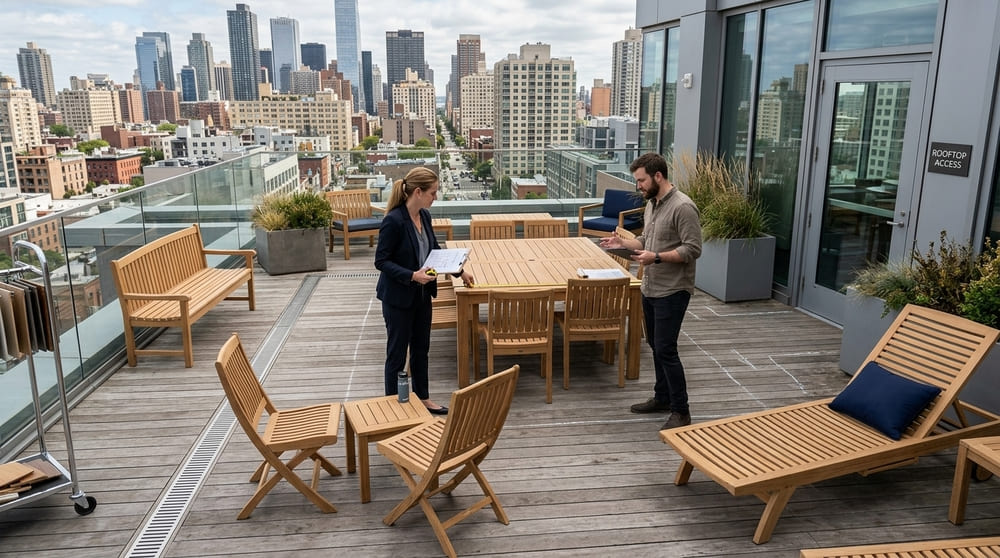
Compare the actual product dimensions with the floor plan rather than selecting furniture based only on appearance. Check seating capacity, distance between tables, guest circulation, staff movement, and storage requirements where relevant.
For example, a chair may fit beside a dining table but still create a circulation problem when it is pulled out. Likewise, a large table may provide enough seats but reduce the space available for service staff.
2. The Same Model Will Be Used Across Multiple Areas
Catalogue products can support standardization when the same chair, table, bench, or lounger will be repeated across several terraces, restaurants, rooms, or properties.
For coordinated dining or outdoor areas, buyers can also review Kusuma Furniture's catalogue teak furniture sets as an initial reference before deciding whether modifications are necessary.
Choose Semi-Custom Furniture If You Only Need Limited Adjustments
Semi-custom teak furniture is suitable when an existing model already provides the required function and general form, but selected details need adjustment. This approach keeps the catalogue model as the starting point rather than developing an entirely new product.
1. Dimensions Need Minor Adjustments
A chair, bench, or table may already suit the design direction but need dimensional adjustments to coordinate with a particular table height, seating capacity, terrace width, or circulation requirement.
The buyer should clearly identify which dimensions need to change and which parts of the original model should remain unchanged. Even a limited dimensional adjustment can affect proportions or construction, so feasibility should be confirmed with the manufacturer.
2. Finishing Needs to Match the Project Concept
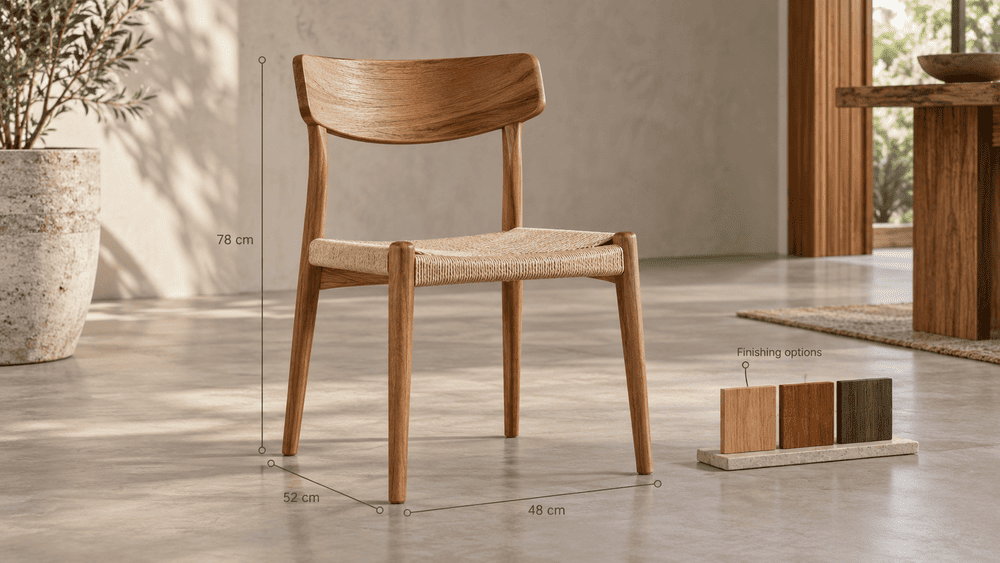
Semi-custom furniture can also be considered when an existing catalogue model already meets the required function and dimensions, but its finishing needs to be adjusted to better match the project's design concept.
However, available adjustments can vary between products. Before including a modified finish or other detail in the project specification, confirm with the manufacturer whether the requested change is feasible for the selected model.
Choose Fully Custom Furniture If Catalogue Products Cannot Meet the Project Requirements
Fully custom furniture is most useful when developing a new product provides a clear spatial, functional, or design benefit that existing products cannot provide. It should therefore be used selectively rather than automatically across the entire property.
1. The Space Has Unusual Dimensions or Shapes
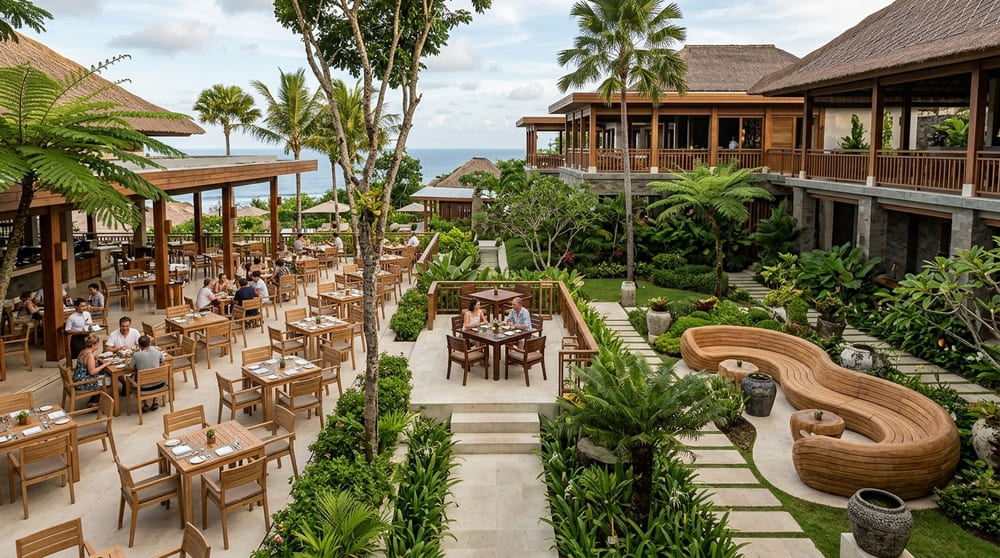
Custom teak furniture for hotels may be appropriate for narrow terraces, curved landscaped areas, spaces surrounding architectural features, or layouts where standard furniture would significantly reduce circulation.
In these situations, furniture dimensions can be developed around the available space instead of forcing the space to accommodate a standard product.
2. The Furniture Must Perform a Specific Function
Fully custom furniture may also be considered when a project requires a particular seating capacity, unusual table configuration, coordination with another project element, or an operational feature unavailable in existing products.
The functional requirement should be documented clearly before design development begins. This helps prevent customization from becoming purely aesthetic when the actual problem is operational.
3. A Focal Area Needs a Distinctive Design Identity
Signature gardens, premium terraces, entrance areas, or major relaxation zones may justify custom hospitality furniture when furniture plays an important role in the property's visual identity and guest experience.
In contrast, back-of-house or highly repetitive operational areas may gain little from the same level of customization.
Compare the Impact on the Procurement Process
The difference between catalogue, semi-custom, and fully custom furniture extends beyond the initial product choice. Buyers should also consider specification work, drawings, samples, revisions, production planning, inspection, and future replacement.
1. Design and Approval Requirements
Catalogue products begin with an existing design, while increasing levels of customization require more project-specific information to be documented and approved.
In hospitality projects, shop drawings can help translate custom items into detailed manufacturing information before production.
2. Production Planning and Project Schedule
Custom products normally introduce additional development and approval stages before bulk production. Semi-custom items may also require review of the modified details.
Do not assume a universal lead time for either option. Actual timing should be confirmed according to the product, quantity, modification level, approval process, and current production plan.
3. Replacement Consistency and Repeat Orders
Catalogue products can generally be referenced through their existing product identification. Custom products require more detailed records so a later order can refer to the same approved design.
For custom pieces, retain the approved drawings, dimensions, finishing references, hardware specifications where applicable, and sample approval records.
The table below shows how the procurement workload can change as customization increases.
| Procurement Factor | Catalogue | Semi-Custom | Fully Custom |
| Product specification | Existing product reference | Existing reference + modifications | Project-specific specification |
| Technical drawings | Verify available information | May be needed for modified details | Important for design approval |
| Sample | Depends on project requirements | Useful for modified details or finish | Important before bulk production |
| Revision process | Limited | Focused on modifications | Potentially more extensive |
| Production planning | Based on selected model and quantity | Includes approved modifications | Begins after design development and approval |
| Repeat-order records | Product reference | Product reference + modification records | Complete approved specification package |
| Replacement identification | Generally simpler | Requires matching the approved version | Depends on retained project documentation |
Use a Hybrid Strategy for Projects with Different Types of Areas
A hotel or resort does not need to choose one furniture ordering method for the entire property. A hybrid strategy allows the project team to match the level of customization to the requirements of each zone.
1. Catalogue Products for Repetitive and Operational Areas
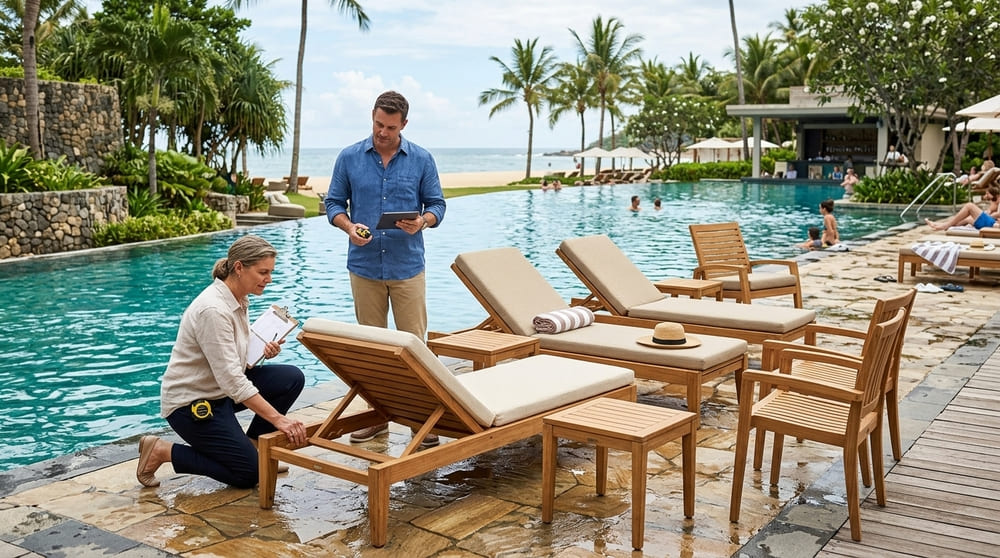
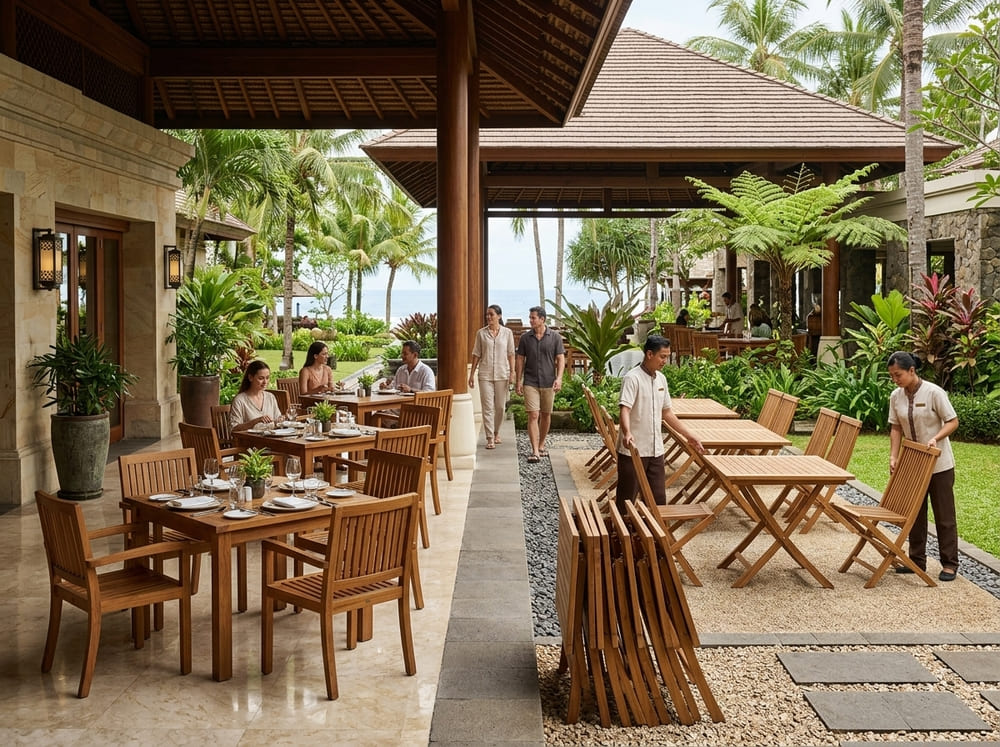
Use catalogue products where consistency, repeatability, and straightforward identification are priorities. These may include repetitive dining areas, terraces, or other zones where an existing product already meets the required function.
2. Semi-Custom Products for Areas Requiring Adjustments
Choose semi-custom when the basic product works but dimensions or finishing need coordination with a particular layout or design concept.
This prevents the team from developing a new product when only a limited modification is actually needed.
3. Fully Custom Products for Focal Areas
Reserve fully custom development for areas where distinctive dimensions, functions, or guest experiences justify the additional design and approval work.
A simple zone-based matrix can help the team classify the requirement before requesting quotations.
| Project Zone | User Activity | Closest Catalogue Product | Adjustment Needed | Quantity | Design Importance | Repeat-Order Need | Order Type |
| Restaurant terrace | Dining | Existing table/chair | None | High | Medium | High | Catalogue |
| Private terrace | Dining/relaxing | Existing model | Dimensions or finish | Medium | Medium | Medium | Semi-custom |
| Signature garden | Relaxing/socializing | No suitable model | New form or function | Low | High | Low-medium | Fully custom |
The examples above are decision scenarios rather than fixed rules. Each project should classify its zones according to the actual layout, quantity, design requirements, and operational needs.
Prepare Information According to the Order Type
Better project information helps the manufacturer evaluate feasibility and prepare a more relevant quotation. The required information becomes more detailed as the level of customization increases.
1. For Catalogue Products
For catalogue products, buyers can start with the basic information needed to identify the selected product and order requirements.
1. Product code or reference
2. Catalogue dimensions
3. Quantity for each model
4. Intended location
5. Finishing option, if available
6. Delivery destination
2. For Semi-Custom Products
For semi-custom products, clearly identify the catalogue model being used as the base and specify which parts need adjustment.
1. Catalogue model used as the starting point
2. Details that should remain unchanged
3. Dimensions or details requiring modification
4. Finishing reference where relevant
5. Quantity and intended area
3. For Fully Custom Products
For fully custom products, provide more complete information so the manufacturer can understand the intended design, function, and project requirements.
1. Technical drawings or available design information
2. Required dimensions
3. Visual references
4. Furniture function
5. Required quantity
6. Site or area conditions
7. Finishing direction
8. Sample approval criteria
Match the Approval Process to the Level of Customization
The approval process should become more detailed as the furniture moves further away from an existing catalogue specification. This prevents unresolved design decisions from reaching bulk production.
Catalogue products can be verified against the selected product reference, dimensions, quantity, and available finishing. Semi-custom orders should additionally confirm every modified detail.
Fully custom products require more comprehensive review of drawings, dimensions, construction details, finishing, and any required sample. Kusuma Furniture's guide explains why hospitality projects should approve the furniture sample before bulk production so dimensions, construction, finishing, functionality, and fit can be reviewed before the same design is reproduced in quantity.
FAQ About Custom vs Catalogue Furniture
These questions can help hospitality buyers determine how much customization their project actually requires.
1. Is Custom Furniture Always Better for Luxury Hotels?
No. Custom furniture is more appropriate when it provides a spatial, functional, or design benefit that catalogue products cannot provide. Luxury positioning alone does not mean every piece needs to be custom-made.
2. Can Catalogue Teak Furniture Be Modified?
Some products may allow limited modifications, but this should be confirmed with the manufacturer. Changes to dimensions or details may affect the original construction and proportions.
3. Does Custom Furniture Take Longer to Order?
Custom furniture generally involves additional specification, drawing, sample, and approval stages before production. However, actual lead time depends on the design, quantity, revisions, production conditions, and approval process, so it should be confirmed for each project.
4. Can Catalogue and Custom Furniture Be Used in the Same Hotel?
Yes. A hybrid strategy can use catalogue furniture for repetitive areas, semi-custom furniture where limited adjustments are needed, and fully custom furniture for selected focal or special-function areas.
Conclusion
If an existing product already fits the layout, function, and design requirement, start with catalogue furniture. If the basic model works but needs limited dimensional or finishing changes, consider semi-custom furniture. Choose fully custom furniture when the space, function, or design requirement genuinely cannot be met by existing options.
Before requesting a quotation, classify each furniture item by order type and prepare the relevant product references, drawings, dimensions, quantities, finishing direction, and sample approval criteria. For properties with several types of spaces, a hybrid strategy can keep customization focused on the areas where it adds the most value.
Start with the Closest Product Before Developing Something New
Hospitality buyers, designers, and contractors can review Kusuma Furniture's benches, tree benches, fixed chairs, folding chairs, extended tables, folding tables, loungers and teak set collections as a starting point for project selection. If an existing product does not fully meet the project requirements, send the product reference together with the required changes or custom design information to discuss the feasibility of a semi-custom or fully custom order.
Recent Articles